What are common orbits, and what use cases do different orbits have?
*Diagrams roughly to scale
Geostationary orbit
Orbit information:
Satellite stays “locked” on one point above Earth. Orbital plane is centered on equator
Altitude: 35,786 km
Velocity: 3 km/s
Orbital period = 23 hr, 56 min, 4 s (one sidereal day)
Three satellites in geostationary orbit can provide near-global coverage
Orbit use cases:
Satellites that benefit from analyzing how the same locations on Earth change over time (e.g., weather)
Communications satellites
Example: NASA’s Tracking and Data Relay Satellites (TDRS)

Low Earth orbit
Orbit information:
180 km ≥ altitude ≤ 2,000 km. The two Van Allen radiation belts above 2,000 km demarcate LEO’s upper limit, and Earth’s atmosphere at 180 km establishes LEO’s lower limit
Speed ~ 7.8 km/s
Orbital period ~ 90 min
More satellites are needed for global coverage as compared to geostationary orbit. These networks of multiple satellites are called constellations
LEO enables higher resolution imagery of Earth than orbits greater distances from Earth, such as geostationary orbit
Satellites in LEO have the advantage of being closer to Earth for easier access
Orbit use cases:
Internet, Earth observation
Example: International Space Station

Polar orbit
Orbit information:
An orbit over the north and south poles of a planet or moon. Polar orbit allows ≤ 10 degrees of orbital plane variance from north-south
Polar orbit is useful to gain widespread coverage of a body because, in addition to the satellite orbiting vertically, the celestial body (e.g., Earth) rotates laterally, enabling the satellite extensive coverage of the body
Orbit use cases:
Satellites that seek extensive coverage of a celestial body (e.g., for imagery capture)
Example: Lunar Reconnaissance Orbiter (LRO)
*Note: the moon doesn’t rotate, so LRO doesn’t have the added benefit of a body’s rotation

Transfer orbit
Orbit information:
Orbit used to transfer from one orbit to another orbit
Orbit use cases:
Transfer orbits are often used when spacecraft exit Earth’s gravity well en route to another body’s gravity well
Example: Artemis II’s transfer orbits during the period between launch from Kennedy Space Center in Florida and trans-lunar injection (visualized below)

Lagrange point orbits
Orbit information:
Lagrange points are points within three-body systems (e.g., the Sun, Earth, and Moon) at which the three bodies “orbit each other, yet stay in the same position relative to each other” (NASA³). At these points, “the gravitational pull of two large masses precisely equals the centripetal force required for a small object to move with them” (NASA³). There are five Lagrange points in the Sun-Earth-Moon system, two of which (L₁ and L₂) are commonly orbited by spacecraft (visualized below in first diagram)
Satellites orbiting Lagrange points stay orbiting those points long-term, as compared to being drawn into either of the two bodies’ gravity wells
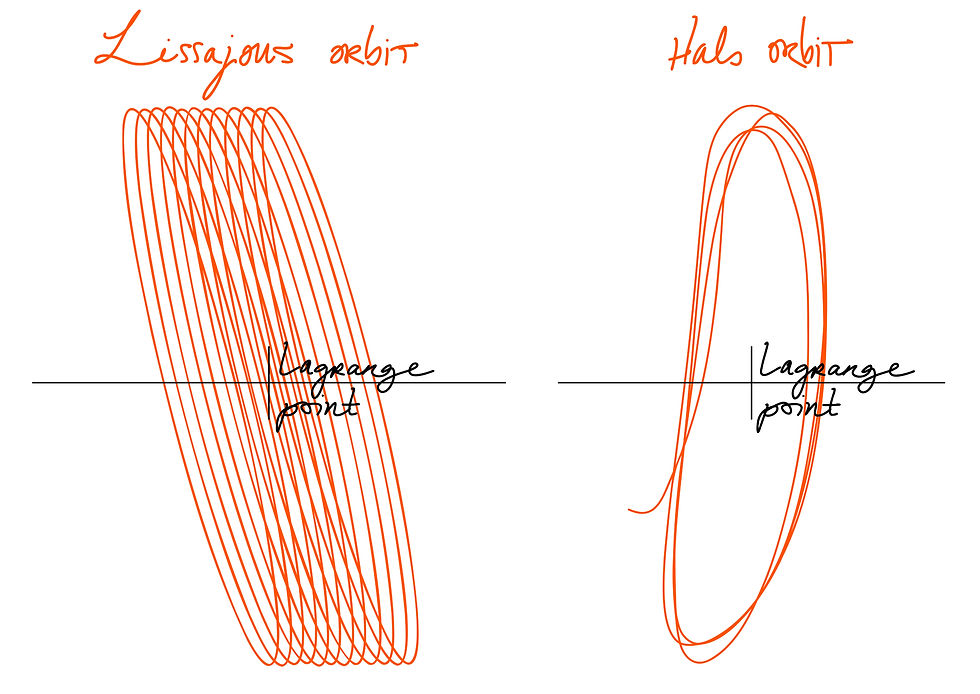
There are two types of Lagrange point orbits: halo orbits and Lissajous orbits (visualized below in second diagram). Essentially, a halo orbit is similar to a “regular” orbit, and a Lissajous orbit shifts in regular increments while maintaining a stable orbital configuration. The Lissajous orbit in the second diagram below is based on Gaia’s L₂ Lissajous orbit
Orbit use cases:
Satellites that benefit from having significant distance from Earth (e.g., satellites affected by Earth’s light or radiation)
Satellites that benefit from a very stable orbit
Examples: James Webb Space Telescope (L₂ halo orbit), ESA’s Gaia (L₂ Lissajous orbit)

_________________________________________________________________________________________________________
Near rectilinear halo orbit (NRHO)
Orbit information:
NRHO is NASA’s chosen staging orbit for the Gateway station that will provide docking support for future Artemis missions
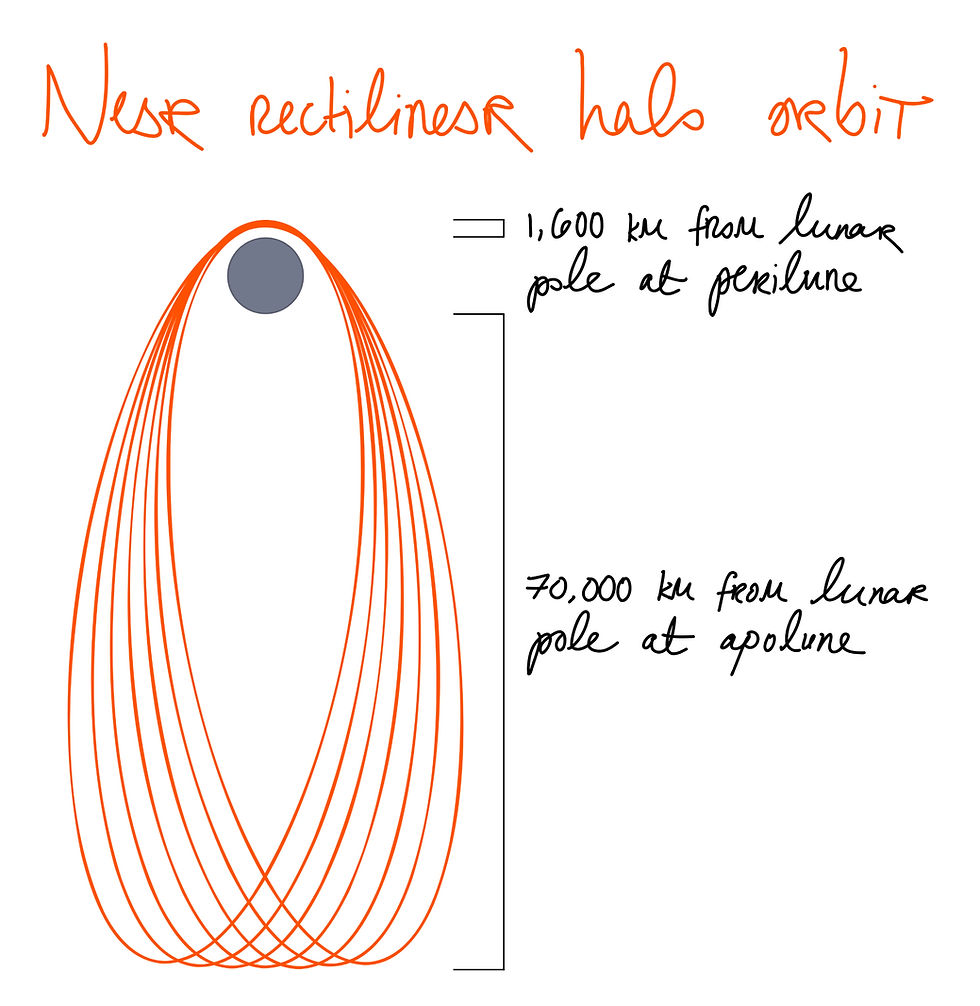
NRHO is a halo orbit passing over the lunar north/south poles
NRHO exists at a neutral-gravity point between Earth and the moon, but NRHO isn’t at the L₂ Lagrange point
Orbit “hangs” from the moon (i.e., NRHO’s diameter isn’t centered on the moon) (see diagram below)
Orbital period = 6.5 days
NRHO is 1,000 mi (~1,600 km) from one lunar pole at the orbit’s closest pass to the moon (perilune), and NRHO is 43,500 mi (~70,000 km) from the other lunar pole at the orbit’s farthest distance from the moon (apolune)
Satellites in NRHO require a small weekly correction to stay in the correct orbital configuration
NRHO also allows for greater Mars extensibility than a low lunar orbit, a distant retrograde orbit, or an Earth-Moon L₂ halo orbit
Orbit use cases:
NRHO is beneficial as a lunar staging orbit because
NRHO requires minimal insertion/departure Δ𝑣 (as compared to a distant retrograde orbit)
NRHO is a stable orbit requiring minimal corrections (as compared to a low lunar orbit closer to the moon requiring raise burns due to orbital decay caused by low lunar orbit being closer to the moon’s gravity well)
NRHO continuously faces Earth, enabling communications
Most of NRHO’s orbit is outside the Sun-Earth eclipse shadow, allowing spacecraft in NRHO sunlight for solar power and thermal consistency (i.e., the thermal conditions affecting the spacecraft are consistent)
Example: Cislunar Autonomous Positioning System Technology Operations and Navigation Experiment (CAPSTONE), Gateway (future)
*CAPSTONE became the first spacecraft put into NRHO in 2022
In summary, space missions select different orbits for their satellites depending on various factors including ease of access from Earth, mission targets (e.g., the lunar surface), propellant required to keep the satellite in orbit, thermal consistency, comms continuity, and more. I really enjoyed learning more about how orbits slot into mission architecture and was both shocked and delighted to find so much academic content analyzing orbital physics and the benefits/drawbacks of different orbits. Reminds me that humans are capable of extraordinary math and space travel abilities, and human spaceflight brings out the best in us in terms of innovation and collaboration.
Thank you for reading this post. The diagrams for Lissajous orbits, general halo orbits, and NRHO are simplified; these orbits are complex, and information I found in cursory online searches was relatively scant in terms of detail. If you have expertise in these orbits—specifically with regard to the burns required to stay in orbit and the unique orbital patterns these burns produce when the orbit is viewed from a certain angle—and want to talk about them, feel free to email me at kelbyk.beyer@gmail.com
Sources: ESA¹, ESA², NASA¹, NASA², NASA³, NASA⁴, NASA⁵, NASA⁶, NASA⁷, NASA⁸, Houston We Have a Podcast: CAPSTONE (Episode 265)
*Sources list includes sources I adapted diagrams from


